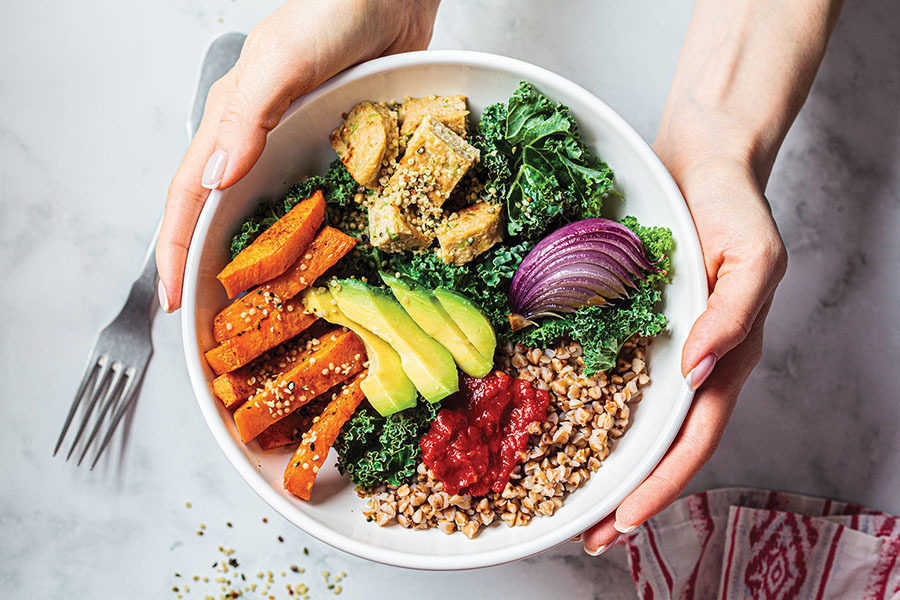
Plant based eating patterns are becoming more popular in Canada, with over 2 million Canadians following a vegetarian diet in 2018.1 Outside of being encouraged as a dietary guideline with the 2019 changes to the Canada’s Food Guide emphasizing intakes for more plant-foods like fruits, vegetables, whole grains and plant proteins, Canadians are focused on:
- The health benefits of eating more plants
- Their carbon footprint through their food purchasing decisions and
- Saving money with the increased cost of groceries.2
This shift in dietary habits may be relatively simple to follow as an individual but how can institutions and food service organizations implement it on a larger scale? With an increase in desire for plant foods, let’s discuss how and why thinking more plant-forward is beneficial for our communities we serve, organizations and the planet.
WHAT IS A PLANT-BASED DIET?
There are various terms to describe plant-based diets, each with their own inclusion or exclusion of some or all animal products:3
- Vegetarian: Consumption of all plant foods with milk (lacto-vegetarian), eggs (ovo-vegetarian) or both (lacto-ovo vegetarian) being permitted animal products.
- Pescatarian: Similar to the vegetarian diet but inclusive of seafood (e.g. fish, shrimp, shellfish).
- Vegan: Consumption of no animal products including meat, dairy, eggs, animal by-products (e.g. honey) or foods that are processed using animal products (e.g. refined cane sugar that is processed using bone char).
- Flexetarian: Primarily following a vegetarian or vegan diet but allows occasional intakes of animal foods.
With an increase in desire for plant foods, let’s discuss how and why thinking more plant-forward is beneficial for our communities we serve, organizations and the planet.
BENEFITS OF PLANT-BASED FOODS
There are many health and operational benefits of integrating plant-based menu items.
- Health Benefits. Eating more plant foods including fruits, vegetables, whole grains and plant proteins (e.g. beans, lentils, tofu, nuts, seeds) have been shown to reduce the risk of heart disease, metabolic syndrome, type 2 diabetes and even various cancers (particularly colon cancer).4
- Cost Savings. Many perceive plant-based proteins to be more expensive than animal products due to meat replacements or analogues often being more costly (e.g. Beyond Meat and Impossible Foods). But whole food forms of plant-based proteins are often more affordable than meats based on equivalent amount of proteins volumes. These include tofu, tempeh, beans and lentils. Incorporating more fruits and vegetables can also be a cost addition but opting for frozen produce can be a more affordable choice while maintaining nutritional value.
- Sustainability and environmental impacts. Consuming more plant foods, and therefore changing the agricultural landscape, can reduce use of water, energy, land use, greenhouse gas emissions and possibly impact biodiversity losses depending on the plant products grown. Opting for produce from local farmers and growers can also help to reduce food related transportation emissions and bring a sense of local connection to folks’ food systems.5,6
- Exploring new menu items. Traditional foods from many cultures internationally are sometimes also fully plant based, allowing institutions to offer new, delicious and unique dishes that are different than our common Eurocentric menu items. South Asian, Japanese, Mexican and Mediterranean cuisines are all delicious examples of cultures with various plant-based dishes.
WHAT ARE THE CHALLENGES?
Eating more plants can feel like a daunting transition with palatability and health needs coming top of mind.
- Taste preferences. There may be expectations for specific textures and flavours of dishes that contain meat, dairy and seafood. Individuals may also have some hesitancy that replacing meat with plant foods will sacrifice the taste of the dish.
- Food service knowledge gap of ingredients to replace animal products. Experimenting with whole-food ingredients that can replace these flavours and mouth feels involves more time, specialization and expertise in balancing taste, texture and food science (e.g. using tofu, seitan, tempeh or legumes in place of animal proteins; opting for coconut milk to add creaminess to a dish).
- Being purposeful with inclusion of specific vitamins and minerals. Some vegetarian diets (in particular, the vegan diet) may lack particular nutrients as they are found in higher amounts or primarily in animal foods. These may include iron, vitamin B12, zinc, iodine and omega 3 fatty acids. All of these nutrients can be found in plants but may need some additional planning and possible support from a nutrition expert like a registered dietitian.7
- Dietary restrictions with some plant-based alternatives. Some meat alternatives contain common food allergens like wheat (e.g. seitan) or nuts to mimic the taste and texture of animal foods.8 Some meat analogues are also considered ultraprocessed foods that may not be a first choice for some health conditions due to the higher amount undesirable nutrients like saturated fats and sodium.
HOW CAN NUTRITION LEADERS IMPLEMENT MORE PLANT-BASED FOODS?
Small changes can result in big impacts! Here are some practical considerations:
- Swap one meal per week with a wholefoods plant-based protein like beans, lentils, tofu, tempeh or other soy products.
- Mixing ½ animal protein with ½ plant-based proteins to add a new texture and transition patients to a new protein source (e.g. making a stir fry with both chicken and tofu; preparing a tomato pasta sauce that contains both ground beef and canned brown lentils).
- Labelling plant-based meals using the name of the dish rather than calling it “vegan” or “vegetarian” so that individuals are not deterred from trying a new option. (e.g. would you choose a “vegan chickpea soup” or a “spiced coconut chickpea curry” if you were presented with both options?)
- Experiment new menu items with a test group of patients, students and/or colleagues to evaluate the desirability of dishes and collect feedback. Then offer favoured dishes for short-term trials while obtaining feedback through surveys or interviews along with food waste measurements to determine how well it is received.
- Removing restrictions on hospital/residential care menus where only those marked as requesting a “vegetarian/vegan” meal are given the plant-based options. Having a plant-based meal always openly available, especially when these are already a menu choice, can help reduce barriers to easily access them.
- Making the vegetarian or vegan meals the first choice on menus and having options with animal proteins be a second choice. (e.g. Falafel is the first choice while chicken souvlaki is the second choice).
- Offering milk alternatives like oat and soymilk beverages on menus without an additional fee to reduce financial barriers.
- Consider training programs that can support food service menu planners, chefs and workers to feel more comfortable with utilizing plant-based ingredients. The Humane Society International’s Forward Food program is one easily accessible option.9
As consumer demand and interest in plant-based food continues to grow, now is a great time to be exploring new and innovative ways to incorporate more plants on menus.
ARE PLANT-BASED MENU ITEMS BEING IMPLEMENTED WITHIN INSTITUTIONS IN CANADA?
The short answer: an exciting yes! Many plant-based menu trials have been conducted in institutional settings in recent years. Some initiatives include:
- Vancouver Coastal Health: The Planetary Health Menu Pilot in 2024. The project developed more than 20 new menu items, evaluated with patient partners then served to patients at Vancouver General Hospital inpatient units on a trial basis. Projects like this showcase the opportunities to offer patients nutritious plant-forward food options that can be desirable, nutritious, support recovery all while aiding the environmental footprint.10
- University of Toronto (U of T): U of T’s Food Services has pledged to make at last 20% of the menu items available to be plant based as part of the university’s sustainability goals. The team collaborated with the “Food Forward for Professionals” workshop to learn strategies and techniques around making ingredient and menu swaps more plant forward while still being appealing and delicious to students.11
- Fraser Health Authority: Royal Columbian Hospital’s, one of the health authority’s largest hospitals, rolled out new plant-based menu items to reduce environmental impacts from food. This change will allow all patients to access two plant-based options as part of the default menu rather than only being provided with these meals if on a vegetarian diet.12
- Dalhousie University: In 2019, based on dollar values, approximately 33% of all food purchased on campus were considered plant based. The Atlantic university aims to have 50% or more of food offerings be plant based by 2030.13
As consumer demand and interest in plant-based food continues to grow, now is a great time to be exploring new and innovative ways to incorporate more plants on menus. Not only can it be a cost-effective way to add nutrient dense foods onto the plates of patients, residents and students but it’s an opportunity to learn new culinary techniques, utilize unique ingredients all while improving the health of individuals and our environment!
Whitney Hussain is a Registered Dietitian in Vancouver, BC for the last decade and is a graduate from the University of British Columbia (UBC). She has worked in a variety of practice settings, including acute care nutrition as a Clinical Dietitian with Fraser Health, Retail and Industry Dietitian in the grocery store setting with Loblaw, and previously instructed at Langara College, the University of Saskatchewan and is a Clinical Instructor at UBC. She now supports the community in her Private Practice with a focus on supporting digestive health, plant-based nutrition, building positive relationships around food, and ensuring folks enjoy their cultural cuisines. You can connect with Whitney at www.whitneyhussain.com or info@whitneyhussain.com.
REFERENCES
1. Statista. (2025). Number of vegetarians and vegans in Canada https://www.statista.com/forecasts/954924/number-of-vegetarians-and-vegans-canada
2. Government of Canada. (2025). Canada’s Food Guide. https://food-guide.canada.ca/en/
3. Clem C, Barthel, B. A Look at Plant-Based Diets. Missouri Medicine. 2021 May-Jun;118(3):233-238. PMID: 34149083
4. Melina V, Craig W, Levin S. Position of the Academy of Nutrition and Dietetics: Vegetarian Diets. J Acad Nutr Diet. 2016 Dec;116(12):1970-1980. doi: 10.1016/j.jand.2016.09.025
5. Carey, C. et al. (2023). The Environmental Sustainabil ity of Plant-Based Dietary Patterns: A Scoping Review. The Journal of Nutrition. March 2023, Pages 857-869. https://doi.org/10.1016/j.tjnut.2023.02.001
6. Eat Lancet. (2025). EAT-Lancet Commission Summary Report. https://eatforum.org/eat-lancet-commission/eat-lancet-commission-summary-report/
7. Key, T, Papier, K. (2021) Plant-based diets and long-term health: findings from the EPIC-Oxford study. Proc Nutr Soc.2021 Oct 27;81(2):190-198. doi: 10.1017/S0029665121003748
8. Abe-Inje, V, Aidoo, R. (2024). Plant-based dietary shift: Current trends, barriers, and carriers. Trends in Food Science & Technology.January 2024, 104292. https://doi.org/10.1016/j.tifs.2023.104292
9. Food Forward. (2025). Transforming Food Service in Canada. https://www.forwardfood.org/canada/
10. Vancouver Coastal Health. (2024). Vancouver General Hospital pilots new plant-rich menu items for health of patients and planet https://www.vch.ca/en/news/vancouver-general-hospital-pilots-new-plant-rich-menu-items-healthpatients-and-planet
11. University of Toronto. (2022). U of T chefs bring more sustainable, plant-based food to campus menus. https://www.utoronto.ca/news/u-t-chefs-bring-more-sustainable-plantbased-food-campus-menus
12. Canada’s National Observer. (2022). Why this hospital is putting more plants on the menu. https://www.nationalobserver.com/2022/08/05/news/hospital-putting-plants-menu
13. Dalhousie University. (2022). Sustainable and Healthy Food Plan. https://www.dal.ca/content/dam/www/about/mission-vision-andvalues/sustainability/Sustainable%20and%20Healthy%20Food%20Plan%20Final.pdf