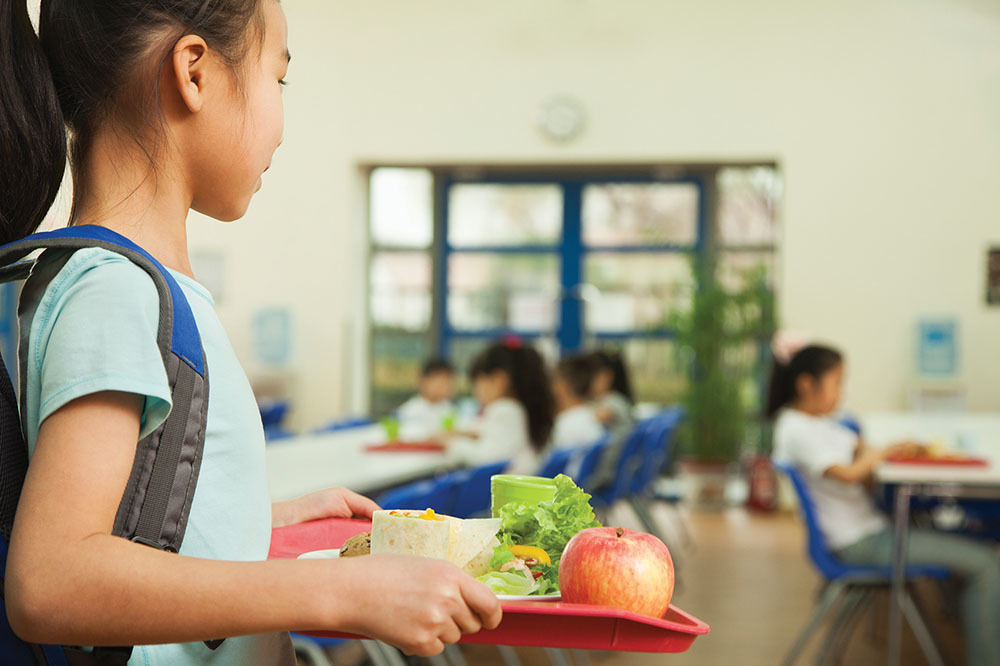
Across Canada, school lunch programs play a critical role in addressing food insecurity while providing students with the fuel they need to learn and grow.
The benefits of healthy school lunch programs are well documented. Aside from reducing food insecurity and obesity rates in children, they have been shown to improve health and boost overall diet quality — because kids who participate are more likely to make good food choices later in life.
Of course, anyone who has ever tried to study with a grumbling tummy FEATURE knows it’s impossible to learn on an empty stomach! Healthy school lunch programs play a role here, too, helping students focus on learning and reducing their overall sick days.
Debbie Field is the coordinator of the Coalition for Healthy School Food, the largest school food network in Canada. She represents more than 350 non-profit member organizations and over 140 endorsers (governments, cities, health units and school boards, for example) who collectively share three common goals. First, advocating for a national school food program for all K-12 students; second, getting provinces and territories to increase their own commitments to student nutrition; and third, helping grassroots organizations strengthen their own community-based school food programs.
Field’s days are busy and include many meetings with politicians of all stripes and their staff. To her, the work comes down to one simple fact: children can’t learn if they aren’t well nourished.
“A school in which children are eating is a calm school,” she said. “There is a calming and unifying effect of being in a place where you don’t have to worry about your next meal.”
“This idea of feeding our children at school so they can learn better, enjoy mental health benefits, and develop a palate for healthy food is an elegant solution — it also provides local economic opportunities for farmers, food service and nutrition professionals.”
— Debbie Field, Coalition for Healthy School Food
She added that Canada was the only G7 country, and one of the only industrialized countries in the world, that didn’t have some kind of harmonized school food program cooperation between the federal government and provincial/city governments.
That’s why the Coalition was encouraged when, in April 2024, Canadian Prime Minister Justin Trudeau announced the launch of a new national school food program. It committed $1 billion over five years to provide meals to 400,000 additional kids every year, beyond those served by existing school food programs. Currently, implementation and funding agreements are being signed with provinces and territories.
Regardless of income levels, Field said Canadian children do not eat the recommended number of fruits and vegetables per day. Instead, they are opting for quick convenience foods loaded with fats, sugar and salt.
“Our children are not eating well,” continued Field. “They’ve been eating less well since World War 2 and a lot less well since COVID. The primary reason is the majority of food being presented to them is packaged and processed — what I call dead food. This idea of feeding our children at school so they can learn better, enjoy mental health benefits, and develop a palate for healthy food is an elegant solution — it also provides local economic opportunities for farmers, food service and nutrition professionals.”
She said children’s hunger is a nonpartisan issue. When it’s addressed, communities are strengthened. Now, the next step is to change the mindset about school food programs — so they are less of an “add-on” and more at the centre of a school’s offering.
“It’s as important as other components of the day,” maintained Field. “Swimming, running, all the other literacies — we need schools to become the hub of healthy eating.”
She knows it’s not going to be a walk in the park, though. Education is underfunded and staff are being asked to do more. Many school buildings are old and lack kitchen facilities where meals can be prepared and stored, which means food service solutions will need to be implemented one school at a time.
“We may need to have hub kitchens that produce some meals,” mused Field. “This is where the expertise of food and nutrition specialists from hospitals, seniors’ residences and daycares will be needed for schools.
“But the biggest barrier now is getting people to see how important it is, to make sure money continues to flow.”
THE POWER OF VOLUNTEERS
From tiny school snack programs to large national entities, volunteerism is a critical component of healthy eating in schools.
In Calgary, Brown Bagging for Calgary’s Kids (BB4CK) prepares thousands of school lunches every day at a cost of $4 each. Stephanie Gauthier, executive director, said the organization delivers lunches to more than 270 schools, with food prepared in a central kitchen as well as 30 volunteer-driven community kitchens.
BB4CK has roots going back to the late 1990s, when volunteers began making lunches for street kids in Calgary. Around 2006, the program shifted its focus to schools.
Today, it feeds more than 7,500 kids every school day from all across the city.
“This is our community, and there’s a growing need,” explained Gauthier. “We know kids who have access to food grow strong brains and bodies, and our mission is to connect kids to the food they need so they can thrive.”
BB4CK’s staff members and 650-plus volunteers have witnessed a large increase in food insecurity in Alberta. Gauthier quoted Statistics Canada findings reporting that nearly one in three households experienced food insecurity in 2023.
That’s why BB4CK’s free lunches and its “low to no barrier” program play an increasingly important role.
“We are a community-funded organization,” said Gauthier. “We believe in the power of community and the incredible things that happen when people come together to ensure kids are nourished, supported and cared for.”
BB4CK receives funding from generous individual donors, corporate partners and foundations. Local businesses can partner with the Feeding Futures program to donate a portion of the sales from selected feature items.
Gauthier said the school food program follows Alberta’s nutritional guidelines for children and youth, selecting its menu items from the “choose most often” category.
“In the school division, most schools operate as emergency food, but this new project is universal so that everyone can eat, no questions asked. Currently, we are operational in three schools, serving 500 meals per day.”
— Jordan Sokmenoglu, Saskatoon Public Schools
“We focus on providing nutritious foods kids need to learn, grow and play. Each lunch includes a sandwich, fruits, veggies, a snack, and dairy twice a week. We offer eight different sandwich options, recently adding a chickpea salad pita as another delicious and nutritious option for kids.”
Gauthier said BB4CK does it best to offer a diverse menu, one that offers options for different dietary needs and cultural preferences.
Cost is a constant challenge. In 2019, it cost a toonie to make each lunch — but that price tag has doubled in just five years. Gauthier credited strong community support — including close partnerships with local food vendors, ongoing community fundraising and a dedicated volunteer program — for the continued success of the initiative.
“Volunteers are the heart of BB4CK,” she said. “They show up every day with incredible energy and dedication, ready to roll up their sleeves, making sandwiches and preparing veggies. We’re committed to making sure they feel valued, connected and appreciated.”
Meanwhile, BB4CK is always looking for opportunities to reach more kids, said Gauthier. “We don’t have a waitlist, so when a new family or school reaches out, we make sure they get support within a couple of days.”
FUNDING FOR THE FUTURE
In June 2024, the Public Health Agency of Canada (PHAC) provided a grant of nearly $3 million over four years to the Saskatoon Public Schools Foundation and Saskatoon Public Schools. The money has been earmarked to promote healthy eating among primary students from Pre-K to Grade 8, through the expansion of the existing lunch pilot project to up to 10 schools. The Foundation was also tasked with developing a school food worker training program and a long-term school food development plan for Saskatoon.
Currently, the school division serves an average of 4,000 daily breakfasts, snacks and lunches in 18 schools, at no cost to students, all funded by community donations.
“Saskatchewan has the lowest per-student funding for school programs across Canada,” said Jordan Sokmenoglu, manager of school food programs for Saskatoon Public Schools. Her job was created in August 2024 when the grant was obtained.
“In the school division, most schools operate as emergency food, but this new project is universal so that everyone can eat, no questions asked. Currently, we are operational in three schools, serving 500 meals per day. For the course of the grant, the goal is to expand to all 10 community elementary schools in areas with high food insecurity.”
She believes Saskatoon was chosen for the grant because Saskatchewan has the highest rate of food insecurity among the Canadian provinces. According to a recent Angus Reid poll, 50 per cent of residents surveyed are worried about putting food on the table.
In her role, Sokmenoglu is very operationally hands-on. A big chunk of her time is spent planning menus, sourcing recipes, standardizing inventory and purchasing supplies.
“I’m also involved in a more visionary role, with longer-term goals such as leasing kitchen space, securing additional funding and meeting with partners and community groups.”
Like many across the country, some Saskatoon schools are housed in old buildings with no capacity for commercial kitchen equipment.
“There are three levels: some schools can produce for themselves and others; some only for themselves; and others have no capacity. We are looking at securing a commercial kitchen space and structuring using the centralized model, where a large amount of food is produced and shipped out. It’s complicated, though, because schools operate independently.”
The program follows the Saskatchewan School Food Standard, “Healthy Foods For My School.” Like Calgary, Sokmenoglu said menus are varied to include a variety of foods.
“Recently, we had Jollof-style rice, a brown Nigerian rice with vegetables and minced chicken,” she said. “We usually serve a veggie tray or salad on the side, plus fruit.”
The Saskatchewan Public Schools program works closely with CHEP Good Food, a local organization that provides brown bag lunches to other schools.Grant applications are often submitted in partnership with CHEP.
As the program continues to roll out, Sokmenoglu said there are currently seven paid staff members, two of whom are full-time.
“In our grant, we have the budget to pay people,” she said. “We have increased the wage as that was a significant challenge for previous programs. Now, we are more along industry standard. There are some volunteers in the kitchen, and we rely on elementary students to help serve lunch, and a group of older students helps with deliveries and donations.”
Sokmenoglu, a certified nutrition manager, is focused on buying local and leveraging the group’s purchasing power to produce more for less.
“We are fortunate because we’ve had previous pilot projects, with some money brought into the division for food. Funding is the biggest challenge,” she said.
The other hurdle is infrastructure. “In one of my schools, we have two domestic ovens for 170 lunches a day. There is no money to upgrade, so we are stuck making it work.”
Sokmenoglu appreciates her chance to work directly with the nutrition workers running the school food program. The ability to check in, find out what they need, listen to feedback, and find applicable professional development opportunities are all rewarding elements of her job.
While she’s working toward standardized menus and ordering, Sokmenoglu said flexibility is key. Every school is different, and plans don’t always work as they were intended.
“Right now, we are on one cycled menu,” she said. “We are focused on building a database of standardized recipes to eventually give the schools some autonomy on what they choose. I was very surprised at our food cost. It’s come down by $1.47 a plate in just four months through standardized ordering.”
The program’s average raw food cost in December 2024 was $1.22 per lunch — in September, it was $2.69. So far, about 80 to 85 per cent of eligible students have opted into the lunches.
It’s early days for the program, and the focus so far has been on refining operations. However, Sokmenoglu pointed out that part of the grant requires establishing a school food culture.
“Where does food come from and why don’t we waste it? We want to engage students in the cooking process. Our partner CHEP is developing programming for us. It’s not just about what’s going on the plate — support must accompany it.”
CONCLUSION
Across the country, there are many organizations, big and small, working to provide children with the nutrition they need to thrive at school. The drive for a national school food program has many advocates who are hungry for change, as they work to fill children’s tummies and fuel brighter futures.